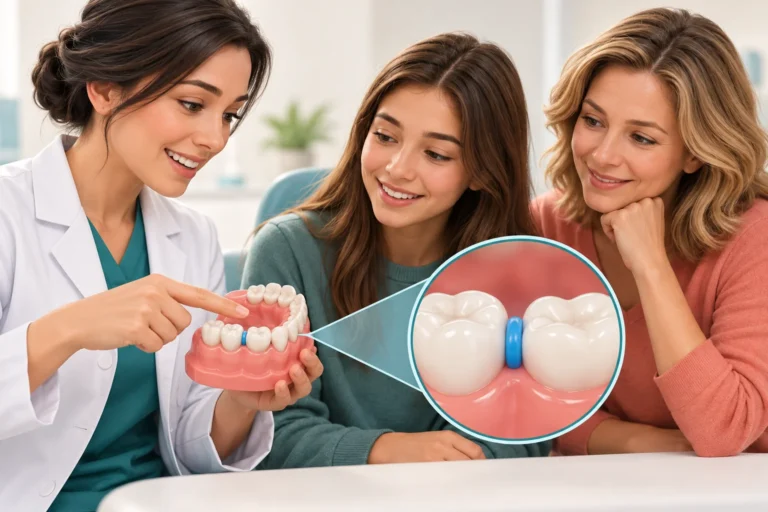
Listen to this article
Prefer listening? Hear the full article at your pace.
A cantilever tooth bridge replaces a missing tooth using support from one side of the gap. However, the word describes the support arrangement, not one universal material or treatment. Therefore, the exact design matters when comparing benefits and risks.[1] [2]
Medical information: This guide explains treatment choices. A dentist must assess your teeth, gums and bite before recommending a bridge.
Key takeaways
- A cantilever has an extension beyond its supporting tooth or teeth.[1] [2]
- Also, crown-retained and resin-bonded designs involve different preparation.[3]
- Research on one design should not be applied to every bridge.[7] [8]
- Cleaning under the false tooth remains essential.[4]
- A loose or painful bridge needs a dental assessment.[6]
How does a cantilever tooth bridge work?
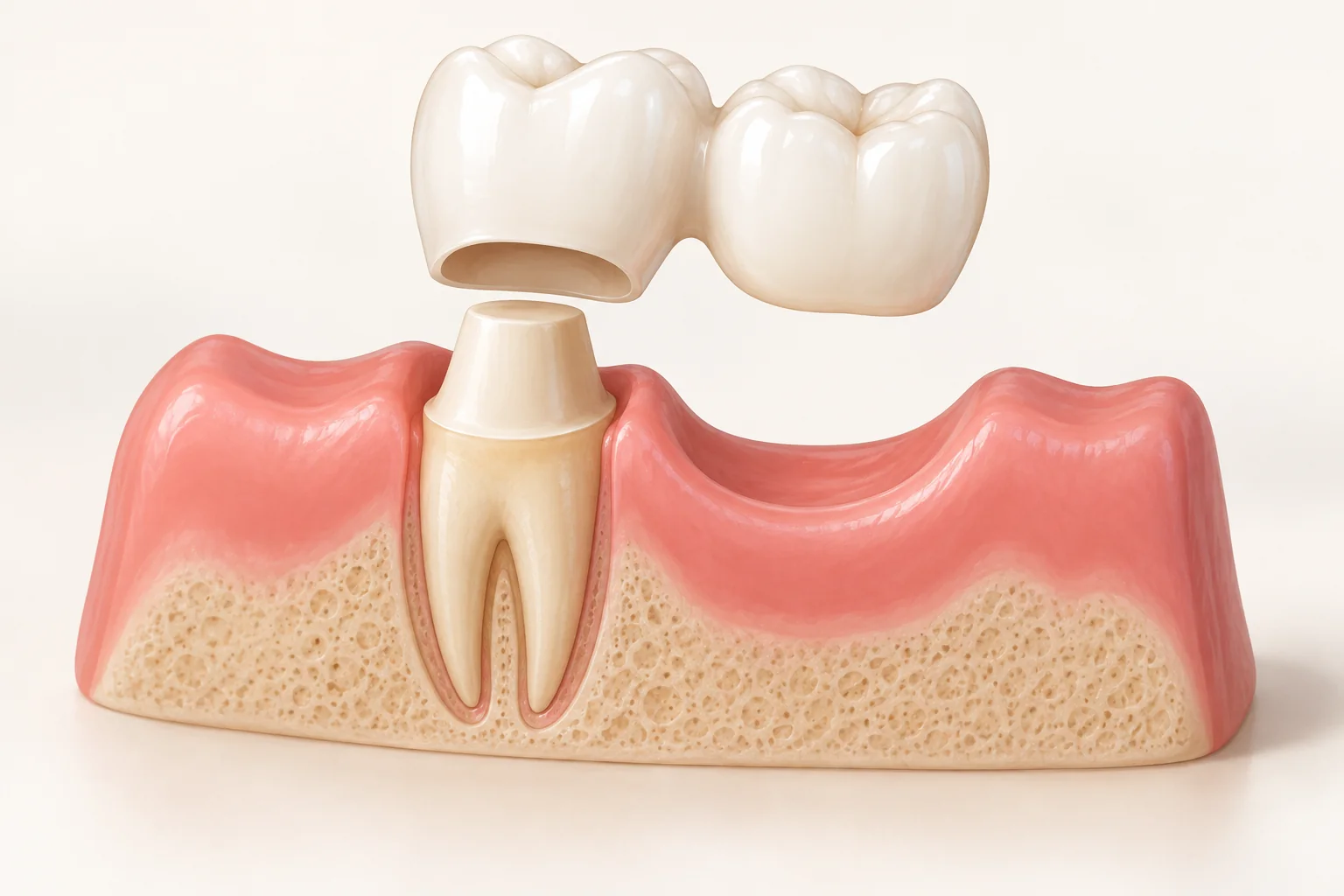
Specifically, the replacement tooth is called a pontic. The natural tooth supporting the restoration is an abutment. In a conventional cantilever bridge, a crown on the supporting tooth connects to the false tooth beside it.[6]
In contrast, a traditional fixed bridge usually has support on both sides of the gap. The Canadian Dental Association describes a cantilever as using adjacent natural teeth on only one side.[2]
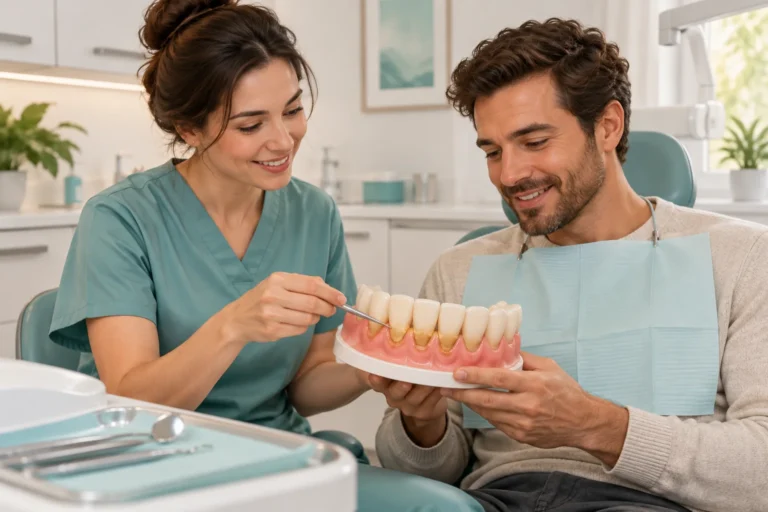
Therefore, ask the dentist to show you the proposed support on a model. Also, ask which natural tooth will carry the restoration and why it is suitable.
Crown-retained versus resin-bonded designs
A crown-retained bridge requires shaping the supporting tooth so that a crown can fit over it. This removes tooth tissue. Therefore, discuss the irreversible preparation before deciding.[3]
By comparison, a resin-bonded bridge attaches a wing to the back of a neighbouring tooth. Also, it often needs little or no drilling. However, it is not suitable for every gap or bite.[3] [9]
| Design | How it attaches | Question to ask |
|---|---|---|
| Crown-retained cantilever | A supporting crown connects to an adjacent pontic.[6] | How much tooth tissue needs removal? |
| Resin-bonded cantilever | A bonded retainer supports a pontic from one side.[7] | Is the enamel and bite suitable for bonding? |
| Traditional bridge | Supporting crowns usually sit on both sides of the gap.[5] | Why prepare two teeth rather than use another option? |
| Implant replacement | A surgically placed implant supports a replacement tooth.[10] | What does surgery, healing and maintenance involve? |
Importantly, “cantilever” and “resin-bonded” are not interchangeable terms. One describes support; the other describes attachment. Confirm both when reviewing a written treatment plan.
Who might be a candidate?
First, the dentist assesses the remaining teeth, the size and position of the gap, and the health of the gums. Also, your preferences matter.[6]
Also, any decay or gum disease needs attention before a bridge plan proceeds. The dental team checks whether the intended supporting teeth are strong enough.[4]
For example, an already heavily restored tooth may make a crown-based option worth discussing. In contrast, an adhesive option may preserve more of an otherwise sound neighbouring tooth.[3]
However, suitability is not something you can confirm from a photograph. Ask for the reason behind the recommendation and how your bite affects the design.
What are the benefits and limitations?
For example, a fixed bridge can restore the appearance and function of a missing tooth. Unlike a removable denture, you cannot take it out yourself for cleaning.[5]
However, a crown-based design can affect the supporting tooth’s pulp and may later require additional treatment. Decay around margins and gum problems are also possible.[3]
A resin-bonded restoration may loosen if the bond fails. For example, the dentist can sometimes rebond it; in other cases, a different solution is necessary.[9]
Therefore, compare more than the initial appearance. Ask what a repair would involve, which complications are most relevant to your case and how follow-up will work.
What does the evidence say about longevity?
A 2018 systematic review examined all-ceramic resin-bonded bridges in the front of the mouth. It suggested better results for cantilever designs than two-retainer designs, but the evidence was limited.[7]
Also, a 2026 systematic review considered posterior resin-bonded bridges. Differences between support designs were not statistically significant, and the authors called for stronger long-term trials.[8]
Specifically, these reviews concern particular bonded restorations. Therefore, they cannot guarantee the lifespan of a conventional crown-retained cantilever in your mouth.
Instead, ask for an estimate based on the exact design, supporting tooth, bite and maintenance plan. “Permanent” means fixed in place; it does not mean indestructible.[6]
Cantilever tooth bridge treatment: what to expect
First, the team completes the assessment and discusses alternatives. Then the dentist prepares the supporting tooth as required and records impressions or measurements for the restoration.[3] [4]
At the fitting visit, the dentist checks the fit and appearance before securing the bridge. Sometimes adjustments require another appointment. Therefore, request your own appointment schedule rather than assuming a fixed number of visits.[9]
Also, ask whether you need a temporary replacement between stages. Tell the practice if comfort or bite problems arise while waiting.

Cleaning and long-term care
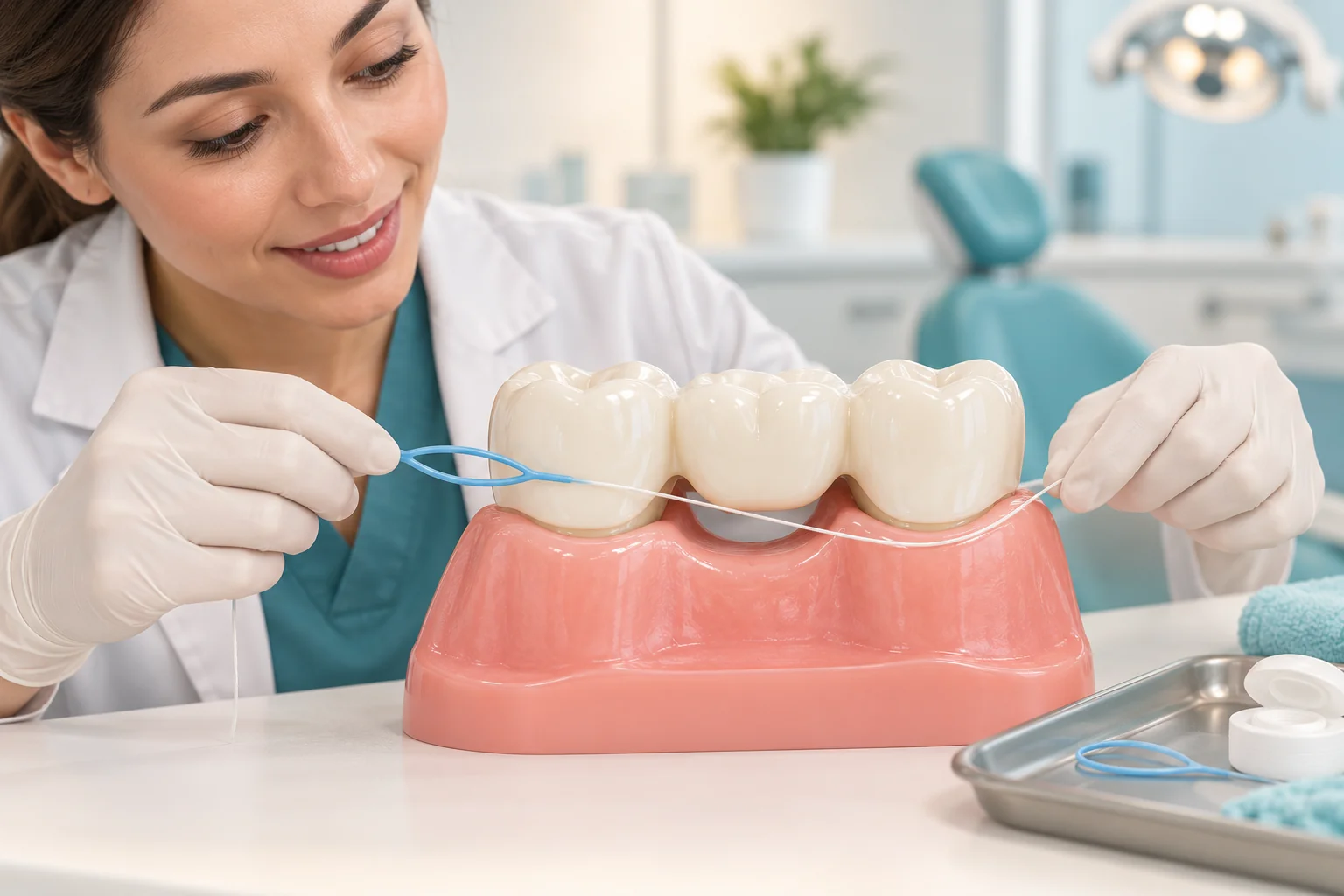
Brush with fluoride toothpaste and keep regular dental appointments. However, connected bridge units stop ordinary floss passing down between them in the usual way. Ask how to clean underneath the pontic.[4]
For example, the team may demonstrate a floss threader or another suitable interdental aid. Therefore, the right method depends on the shape and access around your restoration.[2] [4]
For broader habits, read our oral hygiene guide. Our interdental cleaning guide also explains why tools need adapting around dental appliances.
If irritation develops, see our mouth ulcer guide, then contact the practice about a rubbing restoration. Do not file or glue it yourself.
Alternatives, cost and country differences
Alternatively, a removable partial denture, implant or a decision to leave the gap may be options. Each has trade-offs, and a dental examination helps establish which choices are realistic.[3] [10]
In the USA, India, Canada, Australia and UK, fees and coverage differ. Therefore, request a written estimate that names the bridge design, material, temporary work and follow-up. Also, check what repairs would cost.
For reliable background, read the Canadian Dental Association bridge leaflet and the Leeds NHS bridge guide.
Frequently asked questions
Is every cantilever bridge weak?
No single statement fits all designs. For example, a bonded front-tooth restoration differs from a conventional crown-retained bridge. Ask which evidence applies to the proposed design.[6] [7]
Can I remove it at night?
No. A fixed bridge stays attached. However, a removable partial denture is a different restoration with different care instructions.[3] [5]
What if it starts to move?
Contact your dentist. Also, report pain when biting, cracks or persistent sensitivity. Do not attempt a household-glue repair.[6]
Is an implant always better?
No. An implant involves surgery and a separate assessment. However, a bridge can be a reasonable alternative in suitable circumstances.[5] [10]
Bottom line
A cantilever tooth bridge needs a design-specific decision. Understand the support, preparation and maintenance before choosing. Then compare it with the alternatives using your dentist’s examination and a clear written plan.
References
- American Dental Association — Glossary of Dental Terms: cantilever extension. Accessed 6 October 2026.
- Canadian Dental Association — Bridges patient information. Accessed 6 October 2026.
- Leeds Teaching Hospitals NHS Trust — Bridges. Accessed 6 October 2026.
- Healthdirect Australia — Dental bridge. Accessed 6 October 2026.
- American College of Prosthodontists — Bridges. Accessed 6 October 2026.
- Cleveland Clinic — Dental Bridges. Accessed 6 October 2026.
- Tezulas E et al. Clinical procedures, designs, and survival rates of all-ceramic resin-bonded fixed dental prostheses in the anterior region: A systematic review. J Esthet Restor Dent. 2018;30(4):307–318. doi:10.1111/jerd.12389. Accessed 6 October 2026.
- Thu KM et al. Posterior resin bonded fixed partial denture: A systematic review of five-year clinical outcomes. J Prosthodont Res. 2026. doi:10.2186/jpr.JPR_D_25_00301. Accessed 6 October 2026.
- Cork University Dental School and Hospital — Resin Bonded Bridge. Accessed 6 October 2026.
- American Dental Association, MouthHealthy — Implants. Accessed 6 October 2026.
About this information
HealthyCura shares health and wellness information for general reading. This article does not replace professional medical advice, diagnosis or treatment.