Listen to this article
Prefer listening? Hear the full article at your pace.
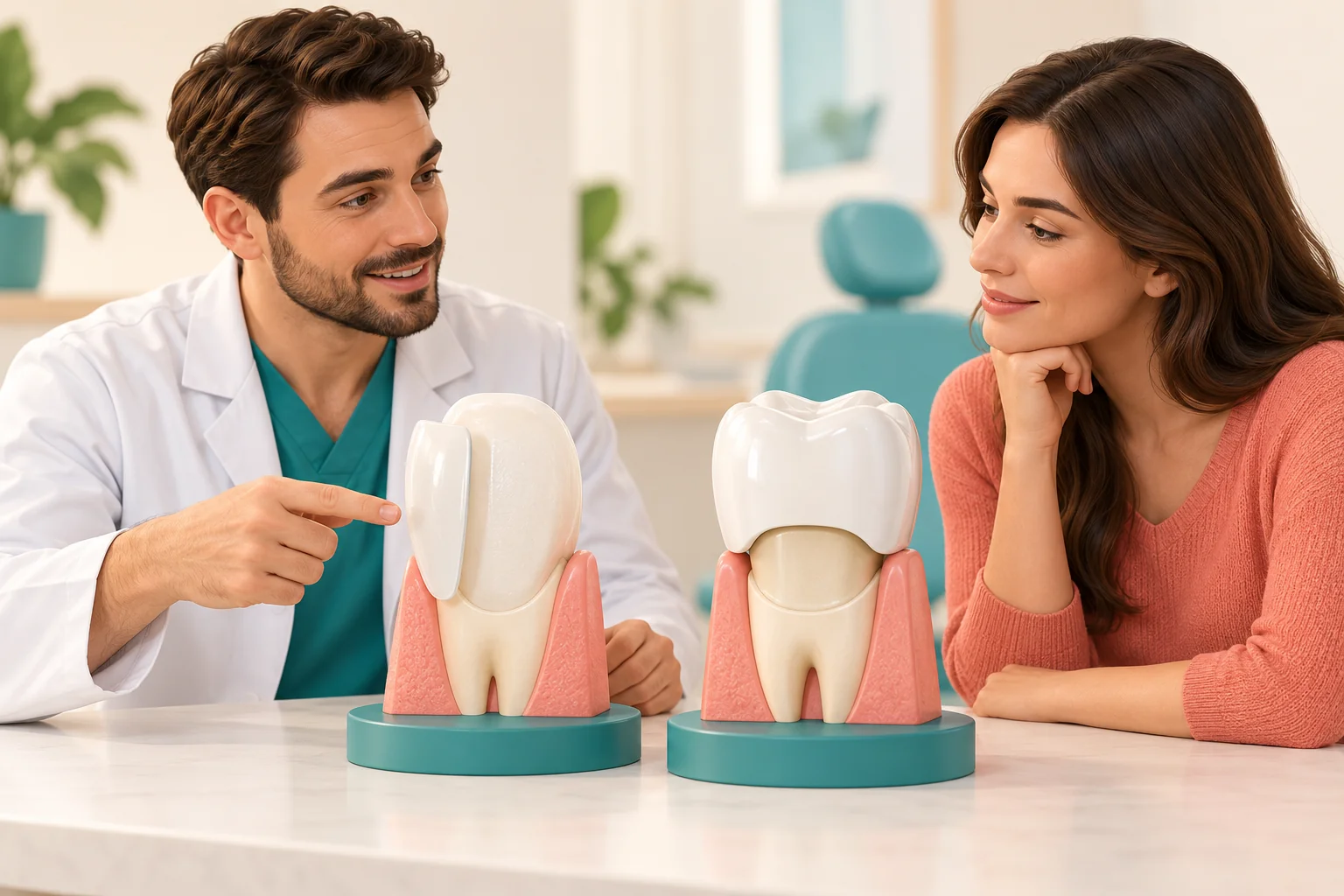
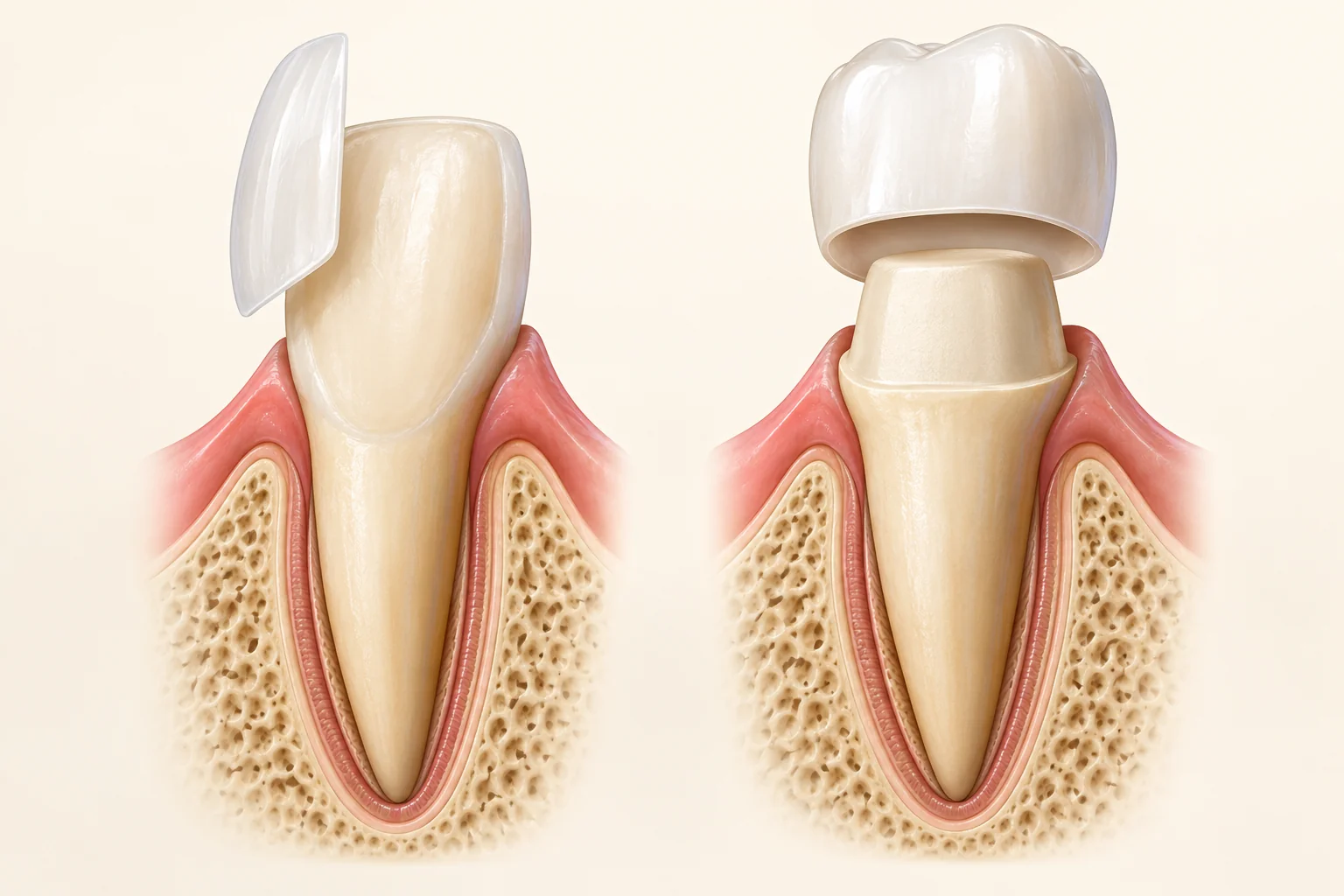
Veneers versus crowns is a comparison of two different ways to restore a tooth. A veneer mainly covers its front surface. In contrast, a crown surrounds the prepared visible tooth and can support a weakened structure. Therefore, the right choice depends on the tooth’s condition, your bite and your treatment goals.[1] [2]
Medical information: This guide supports a discussion with a qualified dentist. It cannot decide which restoration your tooth needs.
Key takeaways
- Veneers and crowns have different coverage and treatment purposes.[1] [2]
- Treat active decay and gum disease before elective veneer treatment.[1]
- Preparation can permanently change natural tooth structure.[3] [4]
- Both options need maintenance and may eventually need repair or replacement.[6] [7]
- A survival statistic is not a guarantee for your own restoration.[8]
Veneers versus crowns: at a glance
| Question | Veneer | Crown |
|---|---|---|
| What does it cover? | Mainly the front surface.[1] | The prepared visible tooth around its sides and biting surface.[2] |
| Common aim | Improve shape, colour or a small cosmetic defect.[3] | Restore and protect a weakened or damaged tooth.[2] |
| Material choices | Usually porcelain or composite resin.[1] | Options include ceramics, metals and combined materials.[5] |
| Tooth preparation | Depends on the veneer design and available enamel.[3] | Space is created for the crown around the tooth.[5] |
| Can it replace a missing tooth alone? | No; a veneer covers an existing tooth.[1] | A crown is a component of some replacement treatments, not a tooth root.[2] |
Use this table to prepare questions. However, do not choose treatment solely from a photograph or a quoted price.
What are veneers?
In general, a veneer is a custom restoration that changes the appearance of a tooth’s front surface. Dentists may use it for selected chips, colour changes, gaps or shape concerns.[3]
For example, porcelain veneers are made for your tooth. Composite veneers use tooth-coloured resin. However, their repair needs, staining behaviour and treatment steps differ.[6]
Most importantly, a veneer is not a way to hide untreated disease. A tooth that looks attractive still needs healthy supporting tissue and appropriate care.[1]
What are crowns, and are caps different?
In other words, a crown and a dental cap are names for the same type of restoration. A dentist may recommend one when a tooth has a large filling, a fracture or substantial structural weakness.[2] [4]
Also, crowns can form part of a bridge or cover a dental implant.[2] However, those are separate treatment plans. This article compares restorations for an existing natural tooth.
Why do dentists recommend veneers versus crowns?
First, clarify the problem you want to solve. A colour concern is different from a painful crack or a tooth with little sound structure left.
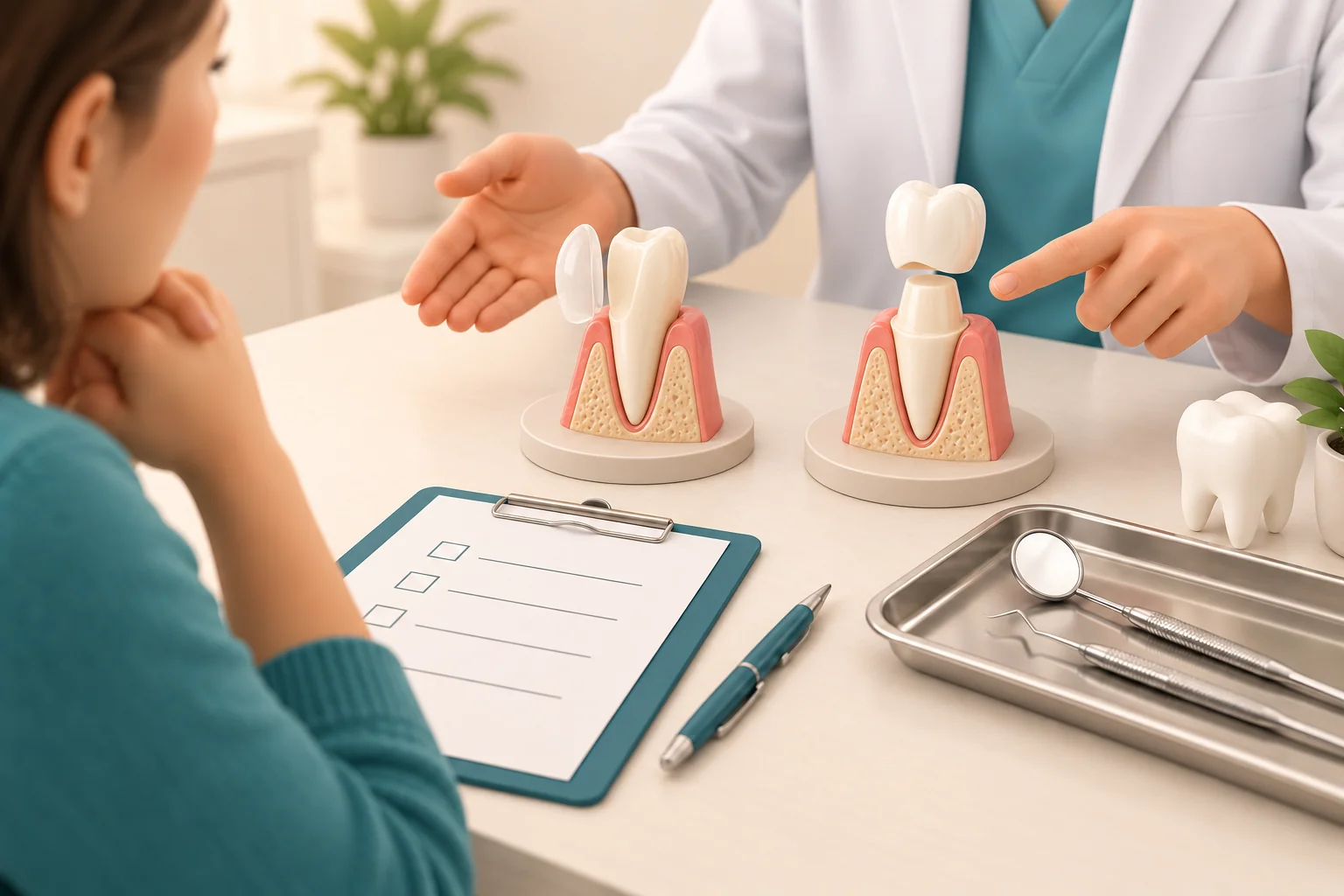
Next, your dentist assesses tooth and gum health, existing restorations and the bite. They may take scans or impressions when planning the restoration.[5] Ask which findings explain their recommendation.
For example, discuss:
- Is my main problem cosmetic, structural or both?
- Is there active decay or gum disease to treat first?
- How much natural tooth will remain after preparation?
- Could bonding, an inlay, an onlay or another approach meet the goal?
- What could happen if I defer treatment?
Some damaged teeth need an onlay instead of a full crown. Conversely, a severely damaged tooth may not be predictably restorable.[4] Therefore, a comparison article cannot replace an individual examination.
What happens during treatment?
Veneer treatment
For a porcelain veneer, the team plans the appearance, prepares the tooth and records its shape. The dentist checks the finished restoration before bonding it. Composite treatment uses a different workflow.[6]
Also, “no-prep” is not a promise that every tooth can avoid preparation. Suitability and the amount of enamel removal depend on the individual case.[3]
Crown treatment
Next, the dentist shapes the tooth and takes an impression or scan. A temporary crown may protect it during laboratory work. The final crown needs checks for fit and bite before placement.[5]
Some equipment allows a same-day crown, while other treatment needs more than one appointment.[7] Consequently, ask about the proposed workflow rather than assuming a fixed number of visits.
Risks and reasons to pause treatment
Veneers can chip or loosen. Clenching, grinding and certain bite problems may affect whether they suit you.[1] Therefore, discuss these concerns before preparation.
By comparison, crowns can chip, become loose or cause problems if the fit is unsuitable. Tooth preparation changes the natural tooth, so maintenance and future treatment remain relevant.[4]
Additionally, compare the scope of the plan. Ask why each tooth needs treatment and whether a less extensive option is reasonable. You can request a second professional opinion before an irreversible elective procedure.
Do not use unlicensed veneer services or try to bond a restoration yourself. The American Dental Association warns that unsupervised treatment can cause harm.[1]
How long do veneers and crowns last?
In general, both can function for years, but neither has a guaranteed lifetime.[6] [7] Daily care, the tooth’s condition and the type of restoration affect the maintenance plan.
For example, a 2021 systematic review analysed 25 studies involving 6,500 porcelain laminate veneers. It estimated 95.5% survival at 10 years. Fracture and debonding were important failure reasons.[8]
However, that figure is a research estimate for porcelain veneers in the included studies. It does not describe composite veneers, every modern technique or your individual outcome. Also, survival does not mean a restoration never needs attention.
Care after veneers or crowns
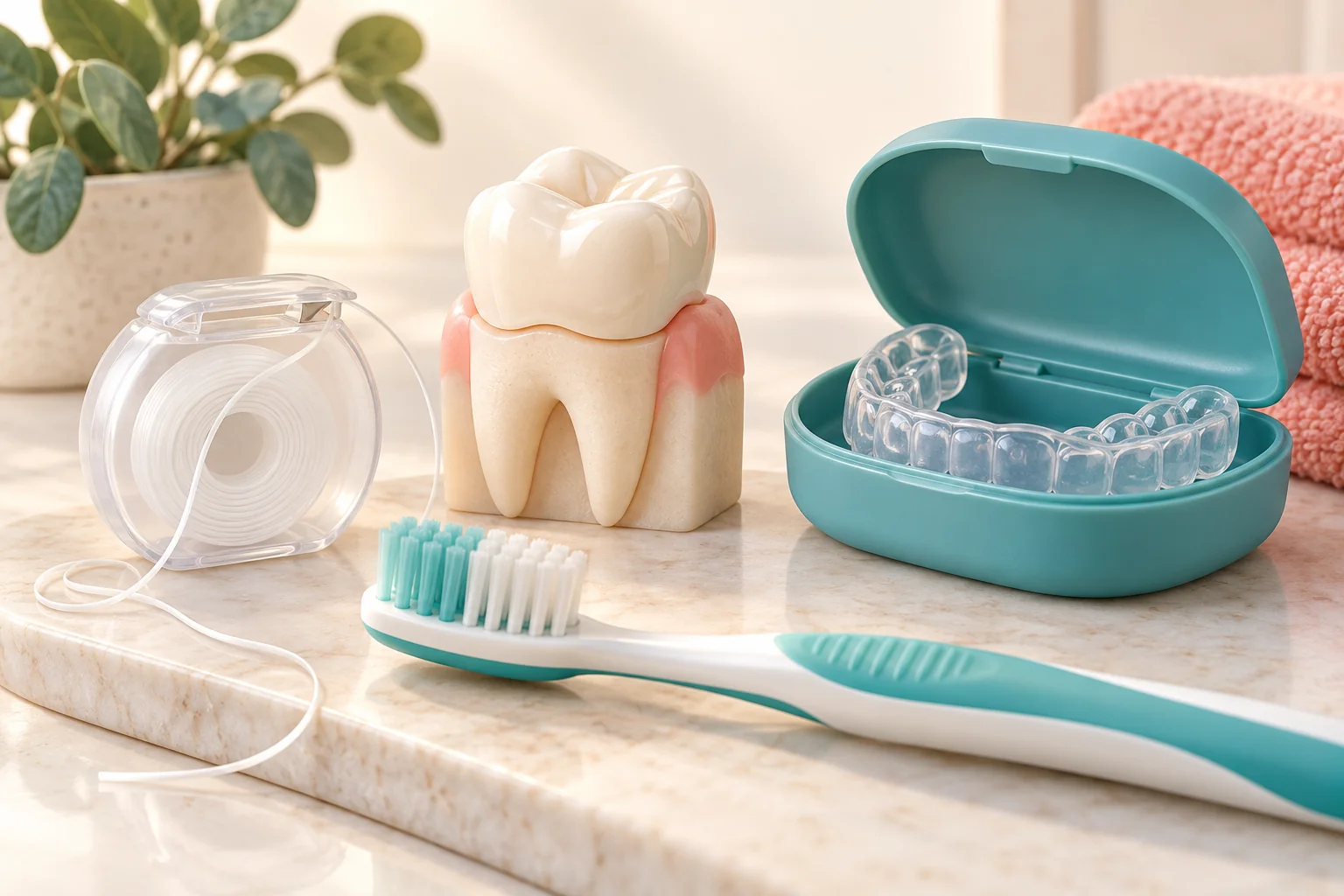
Brush with fluoride toothpaste and clean between teeth daily. Also, avoid biting hard objects and attend the checks your dental team recommends.[7]
Also, if you grind your teeth, ask whether a protective appliance is appropriate.[1] Our oral hygiene guide and guide to dental flossing explain everyday care.
When should a dentist check a problem?
Contact your dentist for a loose restoration, a chipped edge, ongoing discomfort or a changed bite.[4] Do not wait for the next routine check if symptoms are worsening.
Fever with facial swelling needs urgent dental assessment. Difficulty breathing or swallowing requires emergency care.[9]
Also, a painful sore on the mouth lining needs its own assessment. See our mouth ulcer treatment and warning-sign guide if that describes your concern.
Costs and access in your country
Readers in the USA, India, Canada, Australia and the UK should request a local written estimate. Ask whether it includes temporary restorations, laboratory work, adjustments and future repairs.
Also, cosmetic veneer treatment may not qualify for insurance payment.[1] However, do not assume that another country’s prices or coverage rules apply to you.
Australian readers can use Healthdirect’s crown procedure guide to prepare questions. For a UK patient resource, consult the Oral Health Foundation’s veneer information.
Frequently asked questions
Veneers versus crowns: which is better?
Neither is universally better. Instead, the dentist matches the restoration to the tooth’s health, remaining structure and the intended result.[3] [4]
Can a crown improve appearance too?
Yes. A crown can improve appearance while restoring a weakened tooth. However, appearance alone does not explain why a full crown is necessary.[2]
Do veneers stop future cavities?
No. Decay can still develop around a restoration, so cleaning and dental checks remain important.[1]
Should I choose the cheapest quote?
Compare the proposed treatment, material, clinician’s qualifications and follow-up as well as price. Ask the practice to explain what each quote includes.
Bottom line
Veneers versus crowns involves different treatment aims and different coverage. Start with an examination and a clear explanation of your options. Then discuss preparation, risks, maintenance and costs before agreeing to treatment.
References
- American Dental Association — Veneers. Accessed 6 October 2026.
- American Dental Association — Crowns. Accessed 6 October 2026.
- Cleveland Clinic — Dental Veneers. Accessed 6 October 2026.
- Cleveland Clinic — Dental Crowns. Accessed 6 October 2026.
- Healthdirect Australia — Dental crown procedure. Accessed 6 October 2026.
- Oral Health Foundation — Veneers. Accessed 6 October 2026.
- Oral Health Foundation — Crowns. Accessed 6 October 2026.
- Alenezi A et al. Long-Term Survival and Complication Rates of Porcelain Laminate Veneers in Clinical Studies: A Systematic Review. J Clin Med. 2021;10(5):1074. doi:10.3390/jcm10051074. Accessed 6 October 2026.
- NHS — Dental abscess. Accessed 6 October 2026.
About this information
HealthyCura shares health and wellness information for general reading. This article does not replace professional medical advice, diagnosis or treatment.