
Listen to this article
Prefer listening? Hear the full article at your pace.
Wisdom teeth jaw pain can arise from inflamed gums, tooth decay or other problems near a back molar. However, jaw-joint or muscle pain may feel similar. Therefore, a dentist needs to identify the cause before recommending treatment.[1] [3] [4]
Medical information: This guide supports a dental conversation; it cannot diagnose the cause of your pain.
Key takeaways
- A partly erupted wisdom tooth can trap food and develop gum inflammation.[2]
- Also, impaction does not automatically mean that extraction is necessary.[1] [6]
- Jaw pain may come from the joint or chewing muscles instead.[4]
- Persistent symptoms need an examination, even without visible swelling.[3]
- Breathing or swallowing difficulty needs emergency help.[8]
Wisdom teeth jaw pain: possible causes
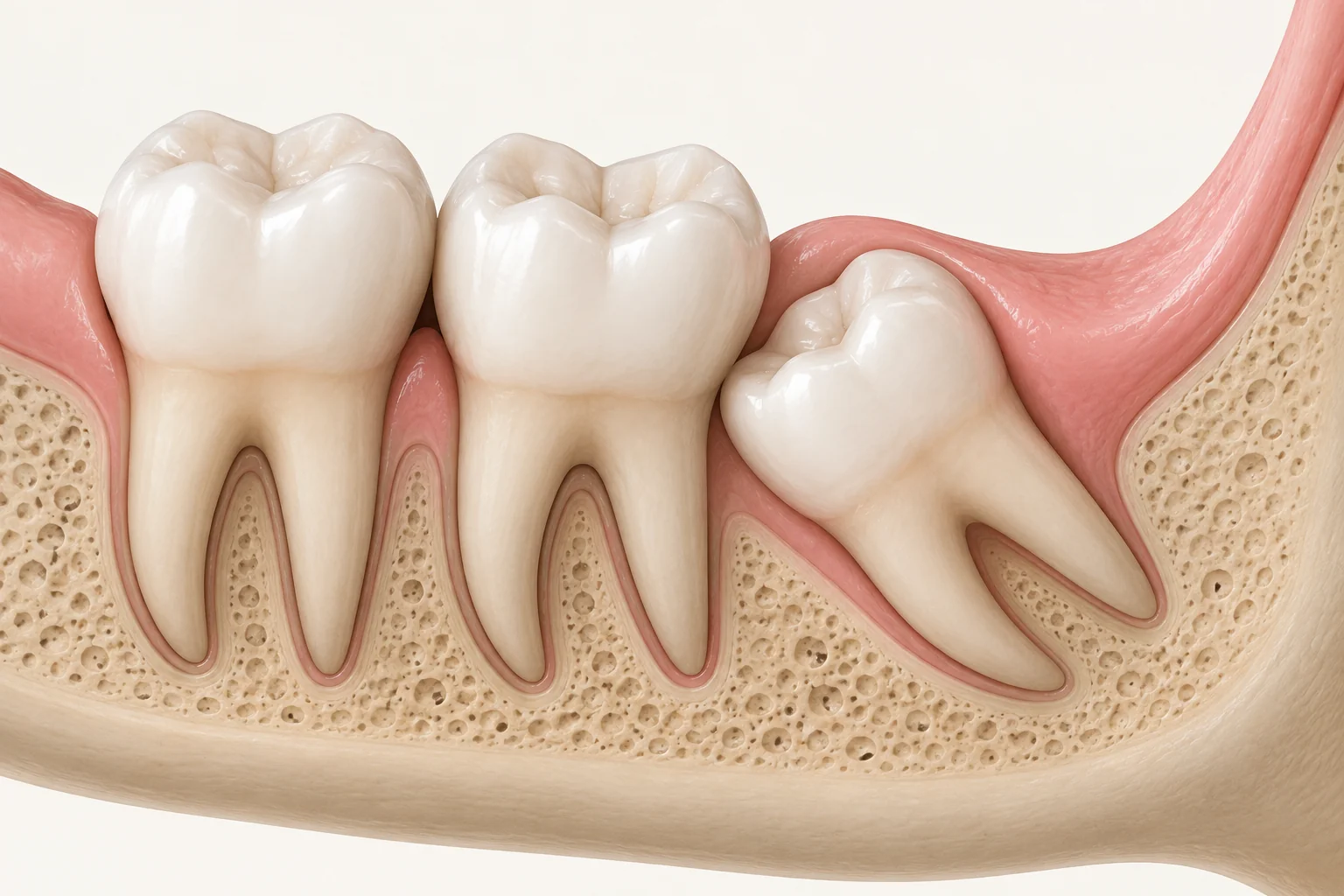
Wisdom teeth are the third molars, at the back of the mouth. They may emerge normally, remain under the gum or come through only partly. An impacted tooth cannot erupt into its usual position.[3]
For example, an inflamed gum flap can make the area sore. Dentists call inflammation around a partly erupted tooth pericoronitis. Decay in that tooth or its neighbour can also require treatment.[1] [2]
Could it be something else?
Yes. Temporomandibular disorders affect the jaw joints, chewing muscles or both. For example, symptoms can include pain, stiffness and locking. However, a painless click alone is common and does not necessarily require treatment.[4]
Therefore, do not use the location of pain as your only diagnostic clue. Also, do not assume that extracting a wisdom tooth will solve a separate joint problem.
Symptoms and urgency at a glance
| What you notice | Next step |
|---|---|
| Recurring soreness behind the last molar, tender gums or an unpleasant taste | Arrange a dental assessment.[3] |
| Severe or worsening pain, swelling, fever or feeling unwell | Seek urgent dental advice.[1] |
| Difficulty breathing or swallowing | Seek emergency care now.[8] |
| Jaw pain with chest pressure, sweating or shortness of breath | Contact local emergency services; do not wait for a dental visit.[9] |
Importantly, these examples do not cover every emergency. If symptoms are rapidly worsening, seek prompt professional help rather than waiting for a routine appointment.
How a dentist assesses the problem
First, describe when the pain started and whether chewing changes it. Also, mention swelling, bad taste, difficulty opening your mouth and any recent dental treatment.
Next, the dentist examines the tooth and nearby tissues. They may recommend an X-ray to assess the position of a wisdom tooth. Together, your symptoms and the findings guide the next decision.[1] [2]
Meanwhile, if a joint or muscle condition seems possible, the assessment may include jaw movement and tenderness. NIDCR explains that other causes must be considered when evaluating TMD.[4]

Does a painful wisdom tooth need removal?
Sometimes, but the answer depends on the diagnosis. Removal may help manage a tooth causing repeated infection, decay or other damage. In contrast, a tooth without a problem may remain under monitoring.[2] [5]
What does the research actually say?
A 2020 Cochrane review examined asymptomatic, disease-free impacted wisdom teeth. It found insufficient evidence to decide whether routine removal or retention was better overall.[6]
However, that finding does not mean an actively infected tooth should be ignored. Specifically, the review concerns a different population. Therefore, discuss the current disease findings, future risks and your preferences with the dental team.
If you retain the tooth, ask what follow-up is appropriate. Monitoring should be a deliberate plan rather than simply forgetting about it.[2] [6]
What is a coronectomy?
For selected lower wisdom teeth close to a nerve, a specialist may discuss a coronectomy. This removes the crown while intentionally leaving the roots. The aim is to reduce nerve injury risk compared with complete removal.[7]
However, it does not eliminate every risk. Some teeth are unsuitable, and retained roots may later need attention. Therefore, ask why the option applies to your case and what follow-up it requires.[7]
What can you do while arranging care?
First, contact the practice and describe your symptoms. Ask how urgently you need an appointment and what comfort measures are suitable for you.
Also, tell the team about your medicines, allergies and relevant medical conditions. Ask a clinician or pharmacist about pain relief if needed. Avoid choosing doses or leftover prescription medicines from online advice.
Keep daily care practical and gentle. Our oral hygiene guide explains routine cleaning. For interdental tools, see our flossing guide, while following advice for the painful area.
Furthermore, a sore spot is not always a wisdom-tooth problem. Our mouth ulcer guide discusses another common reason for mouth discomfort. It cannot replace an examination.

Jaw pain after wisdom tooth surgery
Some soreness and stiffness can occur after removal. However, recovery differs with the procedure and the person. Follow your surgical team’s written instructions rather than a universal online timetable.[5]
Contact the team for worsening pain or swelling, bleeding that will not stop, or symptoms suggesting infection. Also, ask about any persistent numbness or altered sensation.[1]
For the UK explanation, read the NHS wisdom-tooth removal guide. For an Australian overview, see Healthdirect’s surgery information.
Questions to take to your appointment
- Which finding explains my pain?
- Is the neighbouring tooth affected?
- What are the benefits and risks of treating this tooth now?
- If we monitor it, when should I return?
- Could the nerve position change the surgical plan?
- Who should I contact if symptoms worsen?
In the USA, India, Canada, Australia and UK, referral routes and costs vary. Therefore, ask your local practice about the assessment, specialist referral and written estimate before treatment.
Frequently asked questions
Can an impacted tooth cause no pain?
Yes. Some impacted teeth cause no symptoms. Nevertheless, a dental assessment determines whether there is disease or a reason for monitoring.[3] [6]
Does jaw pain prove I need extraction?
No. First, identify the cause. A wisdom tooth, another tooth or a jaw-joint problem may require different care.[1] [4]
Can I wait if the pain comes and goes?
Recurring symptoms still deserve assessment. Also, seek urgent advice if swelling, fever or worsening pain develops.[1] [3]
Will surgery guarantee permanent relief?
No outcome is guaranteed. The team should explain the diagnosis, expected benefit and possible complications before you consent.
Bottom line
Wisdom teeth jaw pain needs a cause-based plan. Arrange assessment, recognise urgent warning signs and ask about treatment alternatives. Then make the decision using your examination findings, not the assumption that every wisdom tooth must go.
References
- NHS — Wisdom tooth removal. Accessed 6 October 2026.
- American Dental Association, MouthHealthy — Wisdom teeth. Accessed 6 October 2026.
- Mayo Clinic — Impacted wisdom teeth: Symptoms and causes. Accessed 6 October 2026.
- NIDCR — Temporomandibular Disorders (TMD). Accessed 6 October 2026.
- Healthdirect Australia — Removing wisdom teeth. Accessed 6 October 2026.
- Ghaeminia H et al. Surgical removal versus retention for the management of asymptomatic disease-free impacted wisdom teeth. Cochrane Database Syst Rev. 2020;5:CD003879. doi:10.1002/14651858.CD003879.pub5. Accessed 6 October 2026.
- University College London Hospitals — Wisdom Tooth Surgery: Advice for Patients Considering Coronectomy. Accessed 6 October 2026.
- NHS — Dental abscess. Accessed 6 October 2026.
- NHS — Heart attack. Accessed 6 October 2026.
About this information
HealthyCura shares health and wellness information for general reading. This article does not replace professional medical advice, diagnosis or treatment.