
Listen to this article
Prefer listening? Hear the full article at your pace.
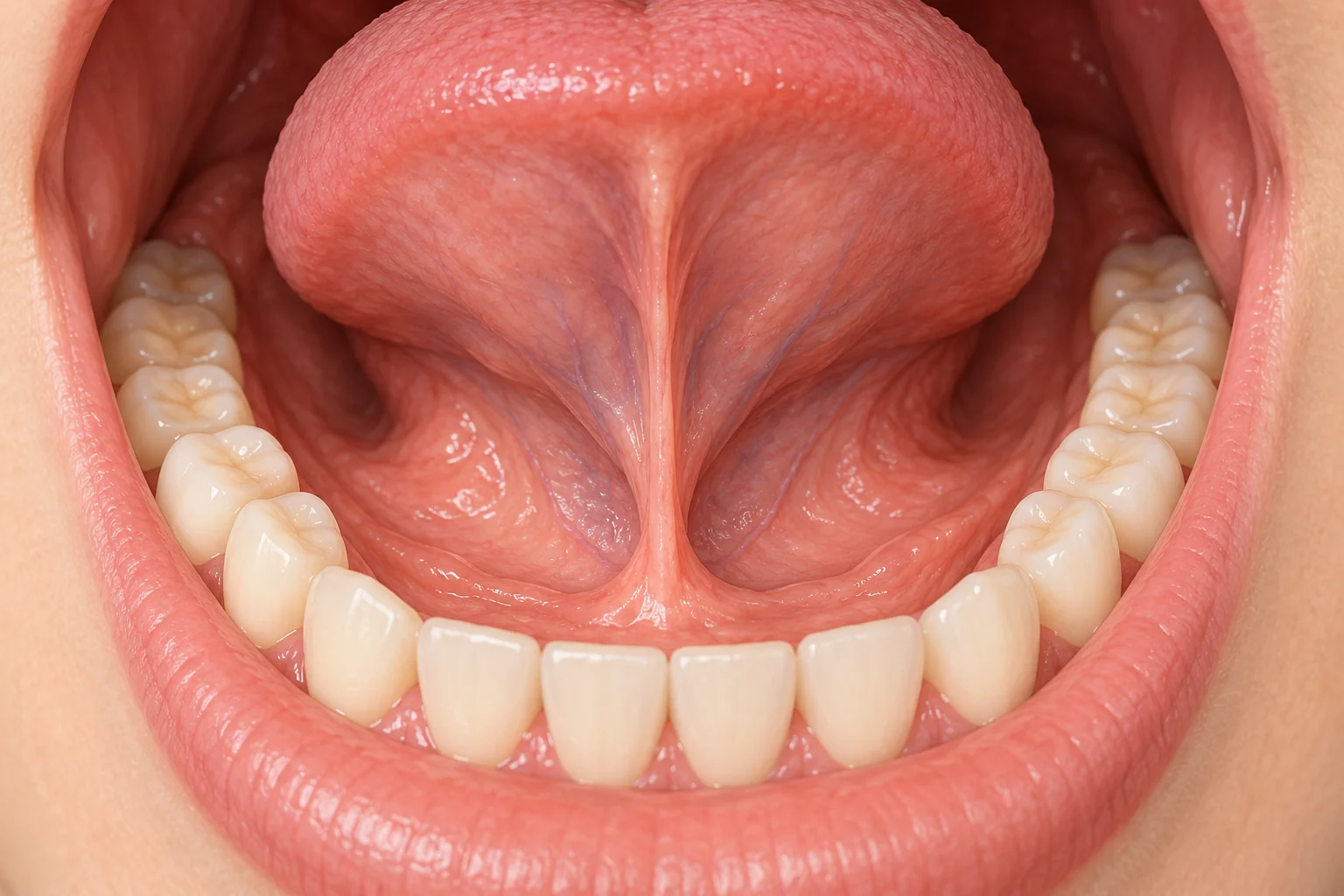
Tongue tie in adults, or ankyloglossia, involves a restrictive tissue attachment beneath the tongue. Also, it can persist into adult life. However, a visible frenulum does not by itself tell you whether treatment is necessary. The effect on function matters.[1] [2] [4]
Medical information: This guide concerns adults. It does not diagnose a tongue-tie or provide instructions for cutting, stretching or treating the tissue yourself.
Key takeaways
- The lingual frenulum is a normal fold of tissue beneath the tongue.[2]
- Restriction can limit movement, but some people have no meaningful problems.[1]
- Also, speech and swallowing concerns may have other causes.[4] [5]
- Adult treatment studies are limited and should not become universal promises.[6] [7]
- A release procedure needs a specific goal and a discussion of risks.[3] [8]
What is tongue tie in adults?
Specifically, the attachment connects the underside of the tongue to the floor of the mouth. However, if it is unusually short or tight, movement may be restricted.[1]
For example, a person may have difficulty lifting or moving the tongue in certain directions. However, a variation in appearance can exist without an important functional problem.[1]
Therefore, distinguish a new concern about how your tongue looks from an activity you have genuinely struggled to perform. Both can prompt a conversation, but they are not the same clinical question.
Symptoms: what deserves assessment?
In a small adolescent-and-adult study, participants reported mechanical limitations, such as difficulty licking their lips, and some reported speech problems. These findings describe a selected group, not every adult with a visible frenulum.[6]
Also, ASHA notes that tongue-tie can coexist with speech sound errors, while the effect of tongue-tie and its release on speech remains debated.[4]
Consequently, an unclear sound or tongue discomfort should not automatically lead to surgery. Ask which finding explains the difficulty and whether another assessment is needed.
| Concern | Helpful next step |
|---|---|
| Longstanding difficulty moving the tongue | Discuss a mouth examination and functional assessment.[1] [3] |
| Speech sound concern | Ask about assessment by a speech-language professional.[4] |
| Coughing during meals, food sticking or unexplained weight loss | Seek a swallowing assessment rather than assuming tongue-tie is the cause.[5] |
| Sudden slurred speech with facial or arm weakness | Contact emergency services now; possible stroke symptoms need immediate help.[9] |
Importantly, a lifelong tissue attachment does not explain every new symptom. Therefore, report when a change began and how rapidly it developed.
How is an adult assessed?
First, explain the specific task that is difficult. A clinician examines the mouth and considers the tongue’s movement. Also, describe previous surgery, dental treatment and relevant health concerns.[3] [4]
If speech or swallowing is the main problem, an appropriate therapist may assess those functions. The care team can then decide whether the tissue attachment is contributing to the difficulty.[4] [5]
However, no online photograph can replace this process. Also, a generic movement score should not become a diagnosis without clinical context.

What does adult treatment research show?
A small adult study
For example, a 2003 prospective study included 15 people aged 14–68. Six underwent reassessment after frenuloplasty and showed improved tongue movement. However, the small selected sample and limited postoperative group restrict what can be concluded.[6]
Therefore, the study supports further investigation, not a guarantee of improved speech or quality of life for every adult.
A study in a specialised population
Also, a 2024 study compared myofunctional therapy with therapy plus frenuloplasty in 155 mixed-age participants with maxillofacial deformity. In that group, it reported better functional outcomes with the combined approach.[7]
However, this was a specific orthodontic and surgical population. The report describes allocation by order of entry. Therefore, its findings should not be generalised to every adult seeking a tongue-tie release.
Similarly, infant feeding research addresses a different clinical question. It should not be used to promise that an adult operation will solve unrelated symptoms.
Does everyone need a release?
No. NHS guidance states that treatment is generally unnecessary when tongue-tie is not causing problems. Also, ASHA describes surgical decisions as individual medical decisions made with the relevant professionals.[1] [4]
For speech concerns, targeted therapy may be part of care. However, exercises are not a universal substitute for assessment, and they should not be copied from an unrelated online programme.[3] [4]
Instead, agree on a measurable goal. For example, identify the activity that treatment aims to improve and how the team will judge whether it helped.
What procedures might be discussed?
A frenotomy releases the restrictive attachment. A frenuloplasty is a more extensive repair that may be considered in selected cases. Therefore, the procedure and anaesthetic plan depend on the clinical situation.[3] [8]
Also, adult surgery should not be described using an infant’s feeding or recovery timetable. Ask what your own appointment, recovery and follow-up involve.
For example, potential complications include bleeding, infection, scarring, reattachment and injury to nearby structures. Anaesthesia can add its own risks. Therefore, discuss the relevant risks and alternatives before consenting.[3] [8]
Do not attempt a home release or forceful stretch. Instead, contact a qualified clinician if a restriction or previous treatment is causing concern.

Aftercare and follow-up
Request written instructions specific to the procedure. Also, ask whether the plan includes therapy and when function will be reassessed. For example, Mayo Clinic notes that exercises may be recommended after frenuloplasty; that does not establish one universal routine.[3]
Also, tell the team about unexpected pain, bleeding or a change that worries you. Keep the review appointment so the clinician can assess healing and the original treatment goal.
For wider care, see our oral hygiene guide and interdental cleaning guide. After surgery, follow the clinician’s instructions for the healing area.
Also, tongue pain or a persistent sore may need a separate assessment. Our mouth ulcer guide explains why not every sore area is a movement restriction.
Questions, access and country differences
In the USA, India, Canada, Australia and UK, referral pathways and coverage differ. Therefore, ask which clinician assesses adults, what the assessment includes and whether therapy is a separate cost.
- Which functional problem have you identified?
- What other causes have you considered?
- What evidence applies to adults like me?
- What are the alternatives to surgery?
- What result is realistic, and how will we measure it?
- What aftercare and follow-up will I need?
For background, read the NHS tongue-tie guide and ASHA’s orofacial function guidance.
Frequently asked questions
Can tongue-tie persist into adulthood?
Yes, some adults have it, although much public guidance focuses on infants. Therefore, ask for an adult-specific assessment.[2]
Will surgery fix my speech?
That cannot be promised. First, identify the speech problem and whether restriction contributes to it. The evidence remains debated.[4]
Can a release be assumed to treat sleep problems?
No. ASHA advises medical referral for suspected sleep-disordered breathing. A tongue-tie assessment should not replace that evaluation.[4]
Should I act on an online photo comparison?
Use it to form questions, not to decide on surgery. Instead, a physical examination and relevant functional assessment matter.[3] [4]
Bottom line
Tongue tie in adults calls for a specific functional question. Assess the problem, recognise the limits of the evidence and agree on realistic treatment goals. Then decide with the relevant clinical team rather than an appearance-based checklist.
References
- NHS — Tongue-tie. Accessed 6 October 2026.
- Cleveland Clinic — Tongue-Tie (Ankyloglossia), including adult considerations. Accessed 6 October 2026.
- Mayo Clinic — Tongue-tie: Diagnosis and treatment. Accessed 6 October 2026.
- American Speech-Language-Hearing Association — Orofacial Myofunctional Disorders. Accessed 6 October 2026.
- American Speech-Language-Hearing Association — Adult Dysphagia. Accessed 6 October 2026.
- Lalakea ML, Messner AH. Ankyloglossia: the adolescent and adult perspective. Otolaryngol Head Neck Surg. 2003;128(5):746–752. doi:10.1016/S0194-59980300258-4. Accessed 6 October 2026.
- Lichnowska A et al. A Prospective Randomized Control Trial of Lingual Frenuloplasty with Myofunctional Therapy in Patients with Maxillofacial Deformity in a Polish Cohort. J Clin Med. 2024;13(18):5354. doi:10.3390/jcm13185354. Accessed 6 October 2026.
- East Sussex Healthcare NHS Trust — Ankyloglossia, June 2025 patient leaflet. Accessed 6 October 2026.
- NHS — Symptoms of a stroke. Accessed 6 October 2026.
About this information
HealthyCura shares health and wellness information for general reading. This article does not replace professional medical advice, diagnosis or treatment.